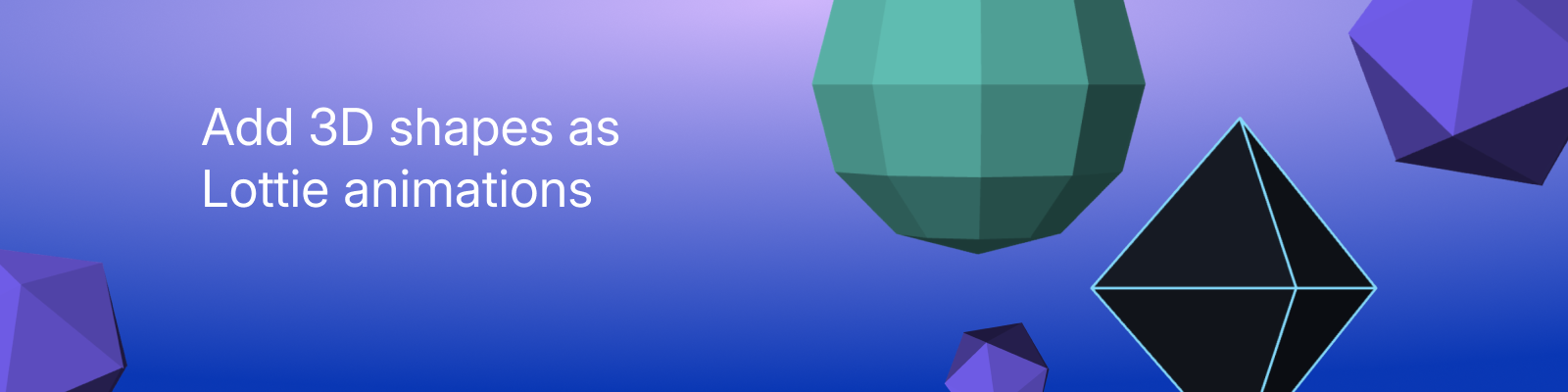
Lottie has no third dimension. This plugin gives you one anyway, by doing the
3D work up front and baking the result into paths Lottie already understands.
Pick a shape, set it spinning, and insert it. What lands in your scene is an
ordinary shape layer: animated bezier paths, animated fills, nothing exotic.
It plays in lottie-web, iOS, Android, dotLottie and anywhere else, with no
expressions, no plugin dependency and no runtime library.
Ten shapes
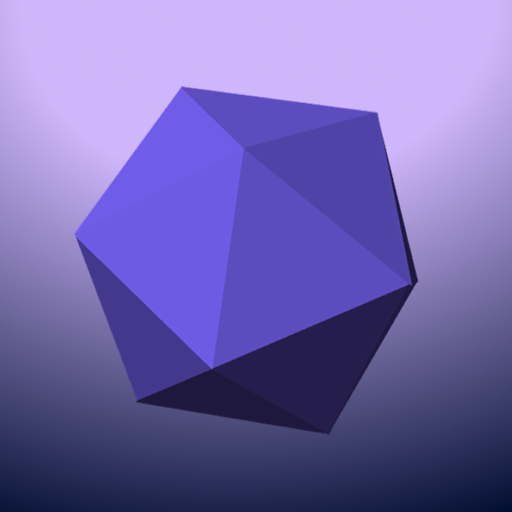
Cube, sphere, pyramid, cylinder, cone, torus, spiral, octahedron,
icosahedron, and a flat plane.
Every one is a real mesh, not a trick of gradients. Sizes are per axis, so a
cube stretches into a slab or a column, a sphere into an egg, a cylinder into
a coin. Drop a cylinder to six sides for a prism, a cone to three for a
tetrahedron, or a torus to six for a nut.
What the bake gives you
True perspective. A pinhole camera with an adjustable lens. Short
lenses give you real foreshortening, long ones go nearly isometric.
Per-face shading. One key light, Lambert shaded, so faces darken as
they turn away. Dial it from flat colour to fully modelled.
Hidden faces removed. Back faces are culled as they turn away, so
solids read as solid.
Seamless loops. Spins are whole turns per loop and the scene holds a
whole number of loops, so the last frame lands exactly on the first. No
jump, no nudging keyframes afterwards.
Optional edges. Add a stroke for a wireframe or a faceted, mesh look.
Three tabs
Motion sets the spin around each axis and the loop length. Shape sets
the size, the mesh detail, the resting tilt and the camera. Style sets
colour, shading, edges. The preview runs the exact geometry the exporter
writes, so what you watch is what you get.
The Optimize slider
Baked 3D means keyframes, and keyframes mean bytes. The plugin samples every
frame, then reduces the result to a pixel tolerance you choose.
At 0% nothing is dropped: every sampled frame ships and faces weld exactly.
Push it up and keys whose absence moves no corner more than the tolerance are
removed. The readout next to the slider shows the live keyframe count and file
size as you drag, so you can find your own balance instead of guessing.
For scale, the shipped presets run from 16 KB for a plane to about 570 KB for
a tumbling torus.
Worth knowing
The geometry is baked, so colours, strokes and layer transforms stay
editable in Creator, but the shape itself is keyframes rather than a live
3D object.
The torus and the spiral are not convex, so their faces are ordered into a
near pass and a far pass at export. That fixes the ordering you would
notice. Pointing a coil's axis straight at the camera stacks its turns
concentrically, which is the one pose where the ordering can slip.
Turns and mesh detail are what cost bytes. A torus or a long spiral is far
heavier than a cube, which is why those presets ship with more optimization.